Temporal Localization of Morphologically-Conditioned Stop Categories in Korean: A Computational Approach

- Chloe Kwon & Fengyue Lisa Zhao. Temporal localization of morphologically-conditioned stop categories in Korean: A computational approach. Talk, Computational Acoustics session, 190th Meeting of the Acoustical Society of America. May 11 – 15, 2026. Philadelphia, PA, USA.
Motivation
The distinction between Korean plain and tense consonants in the word-medial position is subtle because compound tensification allows underlyingly plain stops to surface as tense at compound boundaries. To determine when and where category-related information is present in the acoustic signal, we used a deep neural network-based classification.
Method
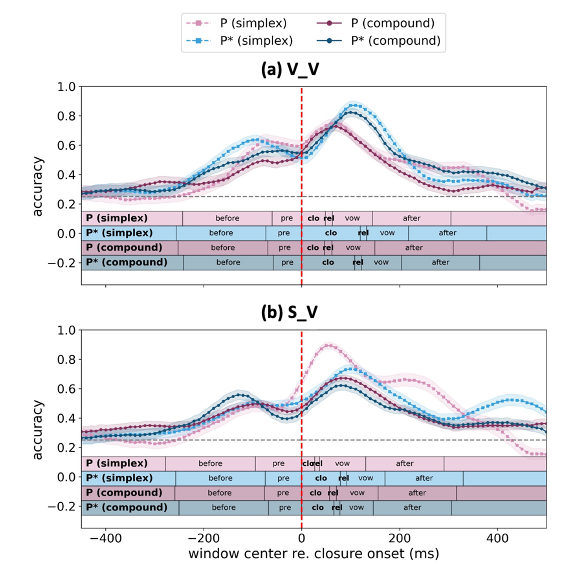
We trained bidirectional LSTM classifiers on MFCCs from sentences containing words across morphological and phonological contexts, using two types of input manipulations relative to stop onset: (1) varying temporal window size extending leftward or rightward, and (2) shifting the center of the fixed-size temporal window to different positions. Models classified stops as plain or tense. We evaluated performance using classification accuracy as well as confusion rates, calculated as the proportion of plain stops misclassified as tense and vice versa.
Results
Results show that category-related information emerges both earlier and later than predicted by standard theoretical assumptions, with stronger effects later in time, indicating carryover from stop closure into the following vowel. Importantly, confusion rates are higher in compounds than in simplex nouns, suggesting reduced acoustic distinctiveness under compound tensification. These findings demonstrate that this method can localize category-related information in time and capture the effects of phonological processes on morphologically conditioned category realization.